
Biomechanics is the science of movement in a living body, particularly focusing on the mechanics of movement, and is part of the larger field of kinesiology. It helps us understand how muscles, bones, tendons, and ligaments work together to produce movement. The forces that load the joints are generated by muscles and transmitted to other tissues by tendons. Bones withstand these forces.
Developments in the field of biomechanics have improved our perspective on normal and pathological gait, the biomechanics of sports injuries, and neuromuscular control mechanics. Thus, it is evolving in terms of medical diagnosis, treatment methods, and what can be done to prevent sports injuries.

In triathlon, the body's biomechanical influence varies for each discipline. In this article, let's discuss the relationship between swimming biomechanics and injury prevention methods.
Forces in Swimming:
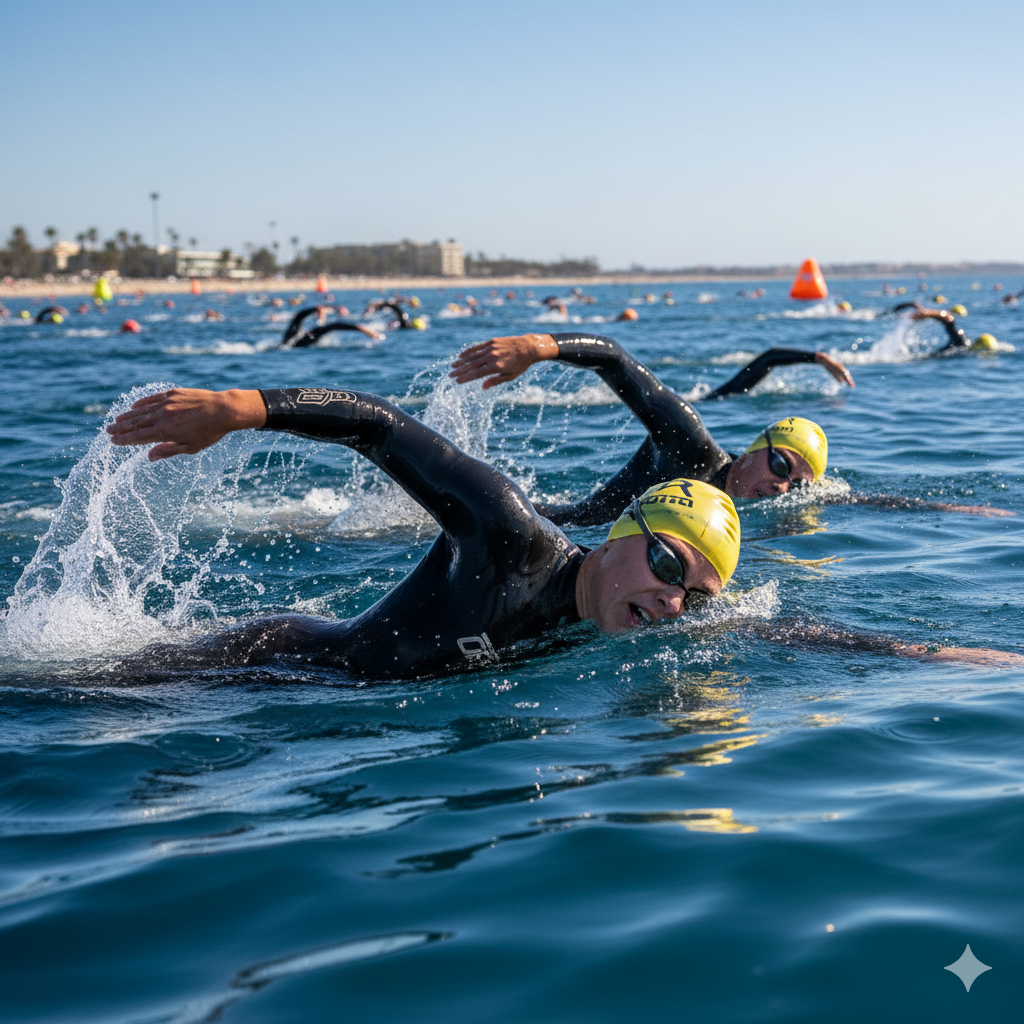
There are several forces that affect the movement of a human body while swimming in water. These forces are drag, gravity, and buoyancy. Drag and lift are the propulsive forces used by swimmers when swimming. The drag (also known as resistance) can be divided into three main categories: frontal drag, skin friction, and vortex drag.
Frontal drag occurs when the body presents a large surface area in the water as it moves forward; it essentially creates a larger surface area that pushes against the water. To minimize the effect of frontal drag, swimmers aim to position themselves as high as possible in the water surface to create a hydrofoil-like effect.
Skin friction is another factor, being the kinetic friction of the swimmer's skin, which is compatible with water. This can be eliminated in various ways. The most popular method is shaving, polishing, or wearing competitive swimwear to remove all visible body hair.
Vortex drag is caused by poor technique creating eddy resistance and very low drag (frontal drag). Water cannot immediately fill the space behind the swimmer. This causes water and air bubbles to be pulled along with them; it slows them down. A swimmer is always exposed to a vortex when applying a pull at the water surface. If the motion is not performed, the vortex remains. If eddies accumulate around the swimmer's body, water resistance increases.
In swimming, buoyancy can best be described by Archimedes' principle: a body that is completely or partially immersed in a fluid is buoyed up by a force equal to the weight of the fluid displaced by the body. This effectively cancels any effects that gravity would have on the swimmer.
The buoyant force is the force exerted by a fluid that corresponds to the weight of the object.
The lift force is the upward force acting on the swimmer while in the water. The pressure beneath the swimmer is much greater than the pressure above, allowing the swimmer to float. Since liquid offers less resistance than air at the water surface, there is less drag. More buoyancy and staying near the surface offers a greater advantage. For an object to float, the lift force must be equal to or greater than the weight of the water.
Drag is one of the main factors affecting the speed at which an athlete moves through the water.
Drag, by its nature, reduces the net force acting in the desired direction of motion as active drag (similar to kinetic friction) works against the movement of the athlete, thereby affecting the athlete's speed of movement in water.
Many athletes spend years working on their technique to produce the lowest possible amount of drag.
There are three main factors in swimming biomechanics:
1- Newton's laws of motion
2- The drag force of water = resistance
3- Lift force
According to Newton's laws of motion; an object at rest will remain at rest unless acted upon by a force.
Extra force is required to overcome static and dynamic forces to initiate and stop motion.
Static Force: When a body is at rest, it wants to remain still, and this must be overcome for fluid movement to occur. The drag felt when movement begins is the static force the swimmer struggles against. Since triathlon swimmers do not have the push of a wall for support, it is crucial for swimming technique and the development of isokinetic strength in the upper extremities.

Dynamic Force: When a body begins to move, it wants to continue moving, and this is what causes swimming to become fluid after the initial movement.
Water is significantly denser than air (773x), and this assists the swimmer’s buoyancy. The higher the swimmer is in the water, the more they return to all the drag forces in swimming.
In swimming, the force generated by the swimmer is equal to the swimmer's mass multiplied by the swimmer's acceleration in the water. This could explain why some people swim faster than others. In this case, since both swimmers have the same mass, the person producing more force experiences greater acceleration. Acceleration is directly proportional to force and inversely proportional to mass. This means that the harder you push off, the faster you move (you gain acceleration).

For every action, there is an equal and opposite reaction. In swimming, when the arm moves downward in the water and then is associated with a standard hand/arm stroke backward to propel the swimmer forward. While creating an equal and opposite reaction, the swimmer is held in a floating position and pushed forward.

In addition to swimming biomechanics, utilizing isokinetic test and exercise systems can be wise for reducing injury rates and enhancing performance. Strengthening the primary muscles used in swimming through isokinetic exercise systems will aid in swimming training and will help reduce the risk of shoulder/hip injuries while also enhancing performance.
The adaptation that the palm and the entire arm will do while in closed kinetic chain exercise against the resistance of water can be achieved by cyclical incorporation of isokinetic system land training. Additionally, as the shoulder moves against resistance of the same intensity at every angle, the muscles will contract isokinetically, concentrically, and eccentrically. This way, optimum fluid movement can be achieved inside and outside of the water. Moreover, isokinetic test and exercise systems are one of the performance assessment methods. This special test administered to the athlete under the guidance of a sports physician is very effective in quantitatively assessing the difference at the beginning and end of an intense training period. There are scientific studies demonstrating performance improvements in athletes who trained for some time with isokinetic test and exercise systems.
In addition to injury prevention methods, conscious stretching and strengthening of the core (abdominal-back) muscles can increase success in maintaining streamline position in the water, thereby enhancing glide and drag movement in water. Stretching exercises incorporating the fascial stretching techniques developed by Canadian Sarah Mariano (thestretchtherapist), which I have also trained in, will be effective.
Furthermore, neurokinetic therapy exercises should be especially utilized for enhancing technique in swimming and enabling the body's biomechanics to be symmetrically employed while swimming.
For this, starting from the eyes, fingers, and toes, neurokinetic therapy exercises for all joints should be learned individually and then combined (sports-specific) movements should be practiced regularly under the guidance of an expert in both land and water training.
Sources :
1-) Kenton Kaufman, KaiNan An, in Kelley and Firestein's Textbook of Rheumatology (Tenth Edition), 2017
2-) https://physicinswimming.weebly.com/resistance.html
3-) The Effect of Isokinetic Training on Maximum Torque Output of Swimmers, Using the Akron Isokinetic Dynamometer V. D. Baltzopoulos and D. A. Brodie School of Physical Education and Recreation, University of Liverpool.
4-) https://infograph.venngage.com/p/94187/biomechanics-of-triathlon
5-) The Effects of Two Different Resisted Swim Training Load Protocols on Swimming Strength and Performance